
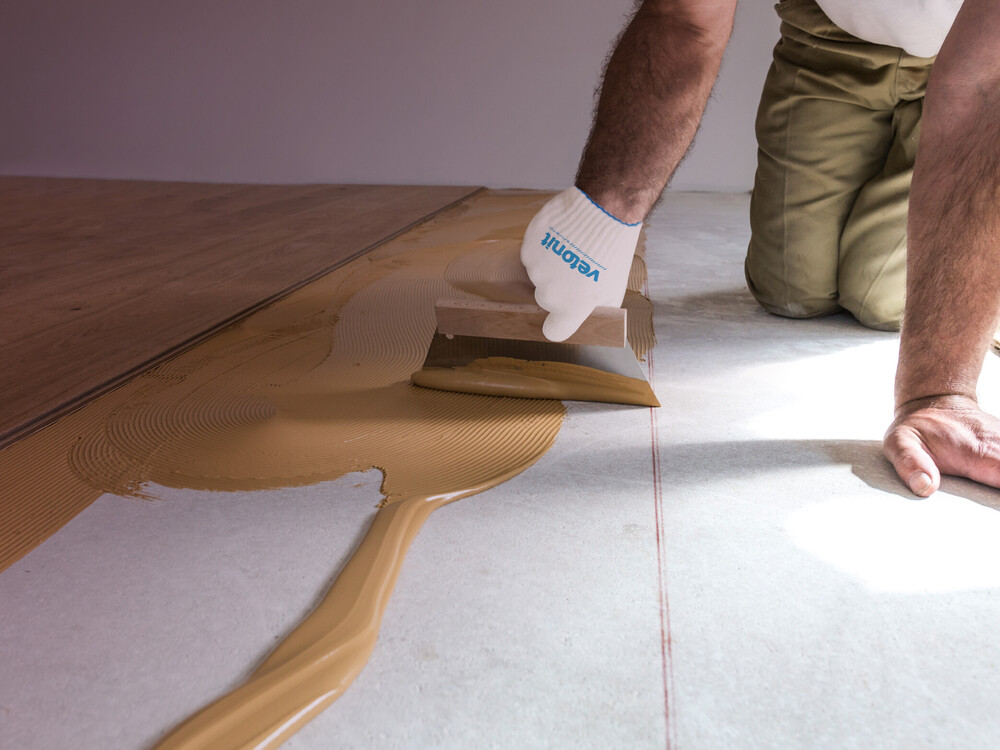

Flooring projects take weeks to select the right material, comparing finishes, debating between two shades of the same color, and then the adhesive gets picked up at the hardware store in about four minutes with almost no research behind the decision. It’s an understandable shortcut. It’s also the one that tends to cause problems six months or two years down the line, when edges start lifting or sections of the floor begin to feel different underfoot than they did on day one.
An adhesive, in most installations, becomes the most consequential decision in the entire project.
Why Standard Adhesives Fall Short in Specific Applications
General-purpose construction adhesives exist to cover a wide range of everyday bonding needs reasonably well. But flooring environments vary and a product built to handle everything nicely often handles specific situations poorly.
Radiant heat systems are a good example. Floors installed over in-floor heating are subjected to repeated thermal expansion and contraction as the system cycles. A standard adhesive that bonds rigidly can’t accommodate that movement. It holds until it can’t, and then it fails in sections.
Moisture and Below-Grade Installations
Concrete floors hold moisture. Not always visibly, but it’s there. That vapor works its way up through the slab constantly, and most standard adhesives are not built to handle it long term. The bond weakens slowly. By the time the floor starts buckling or lifting, the damage underneath has already been done for months.
Basements and ground-level rooms need a product that accounts for this upfront. Some specialty flooring adhesive made for these conditions also act as a vapor barrier, so two problems get handled in one step rather than two.
Most manufacturers require a moisture test before installation. Most installers skip it because it adds time to the job. Redoing a failed floor adds a lot more.
Application Technique Affects Performance as Much as Product Selection
Trowel selection, spread rate, and open time management are variables that determine whether a specialty flooring adhesive performs to its rated specification or falls short of it in real-world conditions.
Open time, the window between adhesive application and when flooring must be set, varies significantly by product and is affected by temperature and humidity on the day of installation. Working past open time means bonding into an adhesive that has already begun to skin over, which dramatically reduces final bond strength. Most installation failures that get attributed to product quality are actually open time management failures.
Trowel notch size controls adhesive transfer. Using the wrong trowel leaves either too little adhesive for proper coverage or so much that the flooring floats on excess product rather than bonding to the subfloor. Manufacturer trowel specifications exist for a reason and are worth following exactly rather than approximating.
Getting the Selection Right From the Start
The range of specialty flooring adhesive products available has diversified in the present days. Each product type sits at a different point on the performance spectrum, what works well for a wood floor over a crawl space subfloor is a different animal from what’s needed for large-format tile in a commercial kitchen. Narrowing it down without flooring experience is genuinely difficult, and the most reliable starting point is whatever the flooring manufacturer actually recommends. Those specs come from real testing against that specific material, not general guidance, which makes them worth taking seriously rather than treating as a suggestion.Those recommendations are tested by the manufacturer against their material and knows what the bond needs to look like over time.
The floor that gets seen and appreciated every day is only as good as what’s holding it in place underneath. That part of the decision deserves the same attention as everything above it.