
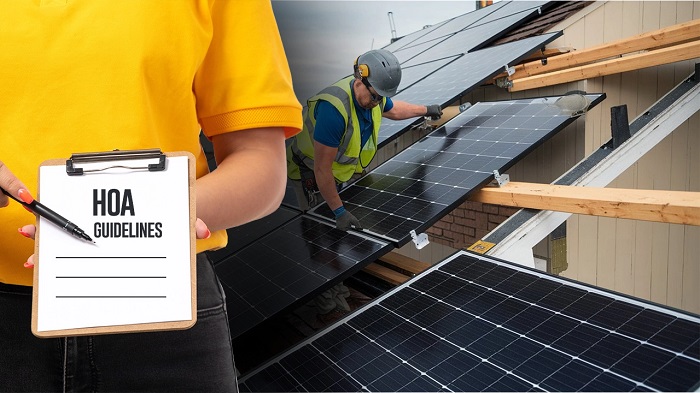

Going solar is an excellent way to reduce monthly energy bills, decrease your carbon footprint, and increase the long-term value of your property. However, for the millions of Americans living in communities governed by a Homeowners Association, installing rooftop panels often involves a frustrating clash between renewable energy goals and strict neighborhood aesthetics.
Understanding your legal protections under state-specific Solar Rights Acts is crucial. While an HOA board has the authority to maintain community design standards, they generally cannot outright ban solar energy systems. Knowing the legal limits of HOA power—and how to effectively navigate the architectural review process—can mean the difference between a smooth installation and a costly legal dispute.
What Is a Solar Rights Act?
More than half of the states across the country, including major solar markets like California, Texas, Florida, and Colorado, have enacted solar access laws. A Solar Rights Act is state-level legislation designed to protect a homeowner’s fundamental right to generate solar energy. These laws achieve this by limiting the enforcement power of an HOA and overriding any community covenants, conditions, and restrictions that attempt to prohibit solar installations entirely.
There is currently no federal law mandating solar rights for homeowners, which means your protections depend entirely on your state legislature. In states with strong solar access laws, any clause in an HOA charter that outright bans solar panels is considered legally void and unenforceable.
However, these laws do not grant homeowners a blank check to install massive, unsightly arrays wherever they please. The legislation is strictly designed to balance the property rights of the individual homeowner with the association’s legal mandate to preserve neighborhood property values and cohesive architecture.
The Scope of Reasonable Restrictions
While HOAs cannot ban solar panels in protected states, they are almost always legally permitted to enforce what the law calls reasonable restrictions. The conflict between homeowners and boards usually centers on how both parties define the word reasonable.
Placement and Aesthetic Requirements
HOA boards typically want solar panels to be as invisible as possible from the street. They may require panels to be installed on the rear-facing side of the roof, mandate that the hardware be mounted flush with the roofline, or insist that the framing and wiring match the color of the existing roof shingles. For ground-mounted systems, the board might require that the array be entirely concealed behind fences or natural landscaping.
Efficiency and Cost Thresholds
To prevent HOAs from using aggressive aesthetic rules as a backdoor method to ban solar, state laws specifically cap how much a restriction can impact the system’s performance or the homeowner’s wallet.
For instance, if an HOA demands that you move your proposed solar array from the highly productive, south-facing front roof to the shaded, north-facing rear roof, that demand is likely unenforceable. In states with robust protections, an HOA cannot enforce a placement rule if it reduces the system’s annual energy production efficiency by more than a specific percentage—often capped at ten percent.
Similarly, they cannot enforce aesthetic modifications if those required changes increase the total installation cost by more than a statutory limit. Depending on the state, this financial threshold is typically capped between one thousand and two thousand dollars. If the board’s design requirements push the cost beyond that limit, the restriction is legally invalid.
The Architectural Review Process for Solar Panels
Even with strong state laws on your side, you cannot bypass your HOA. You are still legally obligated to go through the community’s architectural review process before your contractor ever steps foot on your roof. Operating outside of this process can result in severe fines or a legal injunction forcing you to remove the panels at your own expense.
Review Your Governing Documents
Before finalizing a contract with a solar installer, review your community guidelines. Identify exactly what the board requires for a complete exterior modification application. Understanding their baseline aesthetic preferences allows your installer to design a system that complies with the rules from the very beginning, minimizing the chances of an immediate rejection.
Prepare a Comprehensive Application Package
Incomplete applications are the leading cause of project delays. Ensure your submission is meticulously prepared. A standard solar application should include a detailed roof layout, panel specifications, mounting details, and an energy production estimate.
Providing these technical metrics upfront prevents the board from making arbitrary demands. When the architectural review committee can clearly see the engineering data, they are far less likely to request modifications that would violate state efficiency thresholds.
Anticipate the Approval Timeline
Understand your state’s statutory response deadlines alongside the timelines outlined in your HOA documents. In several states, if the HOA architectural review committee fails to respond to a fully completed application within a certain timeframe—usually thirty to sixty days—the project is automatically deemed approved by default. Keep pristine records of when your application was officially submitted, retain copies of all correspondence, and track the calendar closely.
How to Handle a Denied Solar Application
If your HOA rejects your solar panel application, do not immediately threaten a lawsuit. Often, HOA board members are well-meaning community volunteers who are simply unaware of current state statutes that override their aging neighborhood rulebooks.
Start by reviewing the denial letter against your state’s specific Solar Rights Act. Submit a polite, fact-based appeal referencing the exact state legal code that protects your installation.
If the board insists on an alternative placement to hide the panels from public view, place the burden of proof back on them. Work with your solar contractor to generate a professional shading analysis or production report. You can use this objective data to mathematically demonstrate that the board’s proposed location would reduce energy output beyond the legally allowable limit, effectively rendering their denial unenforceable.
Protecting Your Investment and Your Rights
An HOA board has a strict fiduciary duty to uphold community standards, but they must always operate within the bounds of state law. The transition to renewable energy should not require a bitter neighborhood feud. By thoroughly understanding your state’s solar access protections, submitting a meticulous architectural application, and communicating professionally with your board, you can successfully navigate restrictions and secure a reliable, cost-effective solar energy system for your home.