
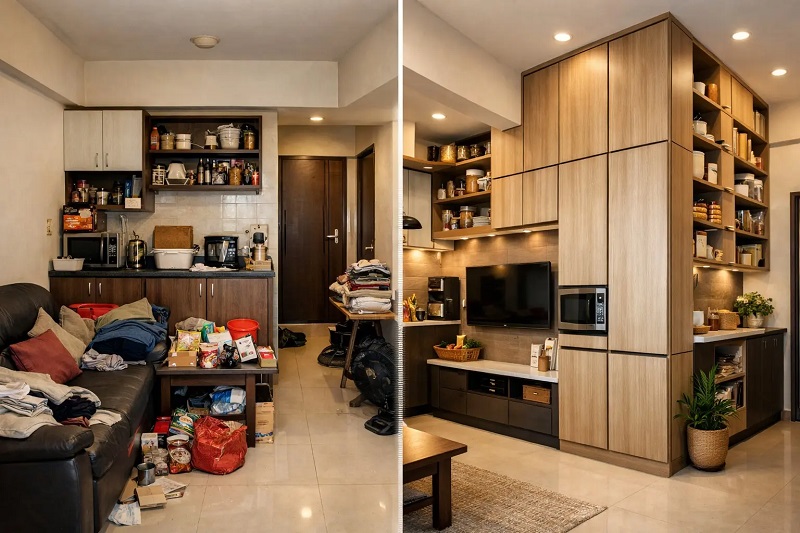

When a compact apartment begins to feel cramped, our default reaction is almost always to blame our belongings. We buy decorative storage bins, reorganize closets, and attempt weekend purge sessions to shed clutter. Yet even after pairing down our possessions to the bare essentials, the space often retains that same heavy, congested feel.
The real culprit is rarely the items we own; it is the furniture holding them.
Most traditional furniture is designed around a four-legged footprint that rests directly on the floor. When you crowd a small studio or tight bedroom with a chest of drawers, a media unit, two nightstands, and a work desk, you create a dense forest of wooden and metal legs. Every leg interrupts sightlines, traps dust, and fragments the floor plane.
To make a small space feel expansive, you have to look beyond two-dimensional square footage and start designing for three-dimensional cubic volume. By anchoring substantial pieces to the wall and elevating functional surfaces off the ground, you preserve critical floor space, restore clear circulation paths, and visually expand the room.
The Architectural Psychology of Visible Flooring
Human perception evaluates the size of an interior space largely by tracking uninterrupted floor planes. When your eye can trace the floor continuously from the center of the room all the way to the baseboards, the brain interprets the room as open, calm, and spacious. The moment bulky cabinets and low-slung credenzas crowd the room’s perimeter, that visual boundary closes in, shrinking the perceived footprint of the home.
Floating your furniture reverses this effect instantly. Suspending a cabinet or media console even eight to twelve inches above the floor allows light and air to pass underneath, maintaining the unbroken boundary of the floorboards.
This is particularly effective with wall-mounted media consoles. Entertainment centers are notorious for gathering dust and consuming valuable walking space in narrow living rooms. Swapping a standard floor unit for a shallow, floating console keeps media equipment and cable clutter tucked away while making the surrounding seating area feel doubled in scale.
Rethinking the Dedicated Workstation
The rise of hybrid work has forced full-sized computer desks into living rooms and bedrooms that were never designed to hold them. A traditional writing desk with drawers and legs quickly dominates an entire wall, claiming floor space around the clock even if it is only used for a few hours each day.
Wall-mounted work solutions eliminate this permanent disruption. Depending on your spatial constraints and everyday work habits, two approaches stand out:
Floating Butcher-Block Slabs
If you require a permanent desktop for dual monitors or desktop equipment, mount a thick, solid-wood butcher-block slab directly to wall studs using heavy-duty structural steel brackets. Because there are no front legs or sprawling trestle bases, your desk chair can slide completely beneath the slab when the workday ends, clearing primary circulation paths. The open space beneath also offers flexible room for a low-profile wastebasket or computer tower without obstructing your legroom.
The Modern Drop-Front Secretary
For compact bedrooms or multipurpose living spaces where work needs to vanish completely outside office hours, the drop-front wall desk remains unmatched. These shallow cabinets measure only six to eight inches deep when mounted to the wall.
When opened, the hinged cabinet face swings down horizontally to form a sturdy, ergonomic desktop backed by interior organizer cubbies. At the end of the evening, you simply close the front panel, instantly concealing your laptop, paperwork, and chargers inside a sleek wall cabinet that claims zero square inches of floor clearance.
Clearing the Floor in the Bedroom
Bedrooms in older homes and modern urban apartments are often barely wide enough to accommodate a queen mattress and clear a swinging closet door. Squeezing conventional nightstands into these narrow gaps turns morning routines into an obstacle course of bruised shins and blocked drawers.
Freeing up bedside floor space requires addressing both the surface and the lighting simultaneously:
- Cantilevered Bedside Shelves: Replace deep nightstand chests with shallow, wall-mounted floating drawers or natural edge hardwood ledges. A floating nightstand provides adequate space for a phone, book, and glass of water while leaving the floor below entirely open. This clearance makes the walkway around the bed feel wide and easily accommodates slippers or under-bed pullout storage bins.
- Hardwired or Plug-In Wall Sconces: Bulky table lamps eat up nearly half of a bedside table’s usable real estate. Mounting articulating arm sconces directly to the wall beside your headboard illuminates nighttime reading without occupying a square inch of table surface.
Reclaiming the Upper Wall Plane
In most standard homes, the vast majority of architectural volume exists between eye level and the ceiling. Apart from the occasional framed art print, this top thirty percent of the room sits entirely unused while living areas below drown in furniture.
Treating this upper elevation as an active storage plane allows you to store substantial quantities of household goods without crowding your daily living zone.
Installing a continuous high-perimeter shelf eight to twelve inches below the ceiling creates a functional architectural cornice. Wrapped around the perimeter of a hallway, small study, or bedroom, this elevated ledge serves as the perfect home for seasonal items, reference books, and archival boxes. Because the shelf sits above normal sightlines, it holds dozens of volumes without imposing on the open feel of the living space below.
The space directly above interior door frames represents another frequently ignored opportunity. A deep wooden box shelf mounted across the header trim of a bathroom, bedroom, or closet door transforms dead wall clearance into a secure, accessible home for folded linens, extra blankets, or canvas storage baskets.
Structural Anchoring and Hardware Realities
Lifting furniture off the ground offers major visual and functional benefits, but it introduces serious mechanical considerations. A loaded floating bookshelf or heavy drop-down desk can easily pull away from the wall if installed with casual hardware.
Never rely on standard plastic expansion anchors when suspending functional furniture. Plastic drywall anchors are rated exclusively for static downward shear loads, such as lightweight picture frames. When you mount a deep shelf or desk, placing books or resting your forearms on the edge creates rotational leverage (cantilever stress) that pulls outward on the top fasteners with incredible force.
Ensure structural safety by following these essential mounting guidelines:
- Fasten Directly into Structural Studs: Use a reliable magnetic or electronic stud finder to locate the center of wood or steel wall framing. Drive high-tensile structural wood screws with wide washer heads through your mounting rails directly into the framing lumber.
- Utilize Heavy-Duty Toggle Bolts: If wall studs do not align with your furniture’s pre-drilled holes, secure the intermediate points using industrial zinc-plated steel toggle bolts. As the toggle wings deploy behind the drywall sheet, they distribute the outward pulling force across a broad surface area.
- Deploy French Cleat Systems: For heavy horizontal cabinets and floating credenzas, nothing matches the strength of an interlocking aluminum or solid-hardwood French cleat. One beveled cleat is leveled and screwed securely to the wall studs, while a matching inverted cleat is built into the back of the cabinet. The furniture drops onto the wall rail, utilizing gravity and wedge friction to create a rock-solid, gap-free installation.
Shifting from Square Feet to Cubic Volume
Living comfortably in a small home does not require resigning yourself to clutter, nor does it mean living in austere deprivation. It is a matter of shifting your focus from the flat floor plan to the entire volume of your interior walls.
When you raise your desks, float your storage cabinets, hang your lighting, and utilize the vertical room right up to the ceiling, your home undergoes a fundamental transformation. Surfaces lift away from your path, light flows uninterrupted across the floorboards, and even the most compact room begins to breathe like a spacious sanctuary.