
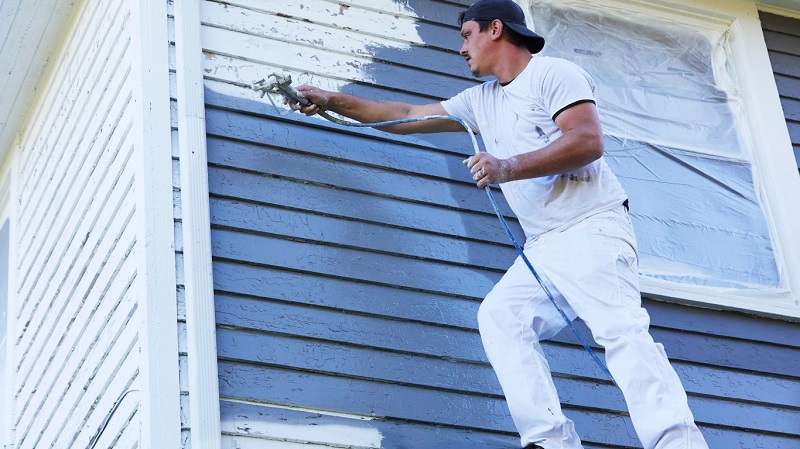

Most homeowners approach an exterior painting project with a single, straightforward criterion: is the sun shining and is the driveway dry? On paper, a bright and clear Saturday morning feels like the ultimate green light to set up extension ladders, open a five-gallon bucket of exterior acrylic latex, and begin coating the siding. Yet experienced painters know that clear blue skies can be just as deceptive as an incoming storm front.
Paint is not merely a colored liquid that dries like wet laundry hanging on a clothesline. It is a complex chemical formula of resins, pigments, additives, and carriers that must undergo a delicate transformation called curing. When applied outside its intended environmental thresholds, even top-tier paint will fail long before its time. It blisters, sags, chalks, peels in sheets, or locks in moisture that rots the siding beneath.
Understanding the balance between ambient air, wall temperature, and atmospheric moisture is the single most important factor in delivering an exterior paint job that holds up for a decade rather than failing after two seasons.
Drying Versus Curing: The Chemistry on the Wall
To understand why environmental conditions matter so intensely, you must first separate the concept of drying from the process of curing.
Drying is the mechanical evaporation of the carrier liquid—either water in latex paints or mineral spirits in oil-based formulas. Once that liquid evaporates, the paint feels dry to the human touch, often within thirty to ninety minutes.
Curing, by contrast, is an ongoing chemical reaction. During curing, the polymer binder particles coalesce, fuse, and cross-link into a continuous, flexible plastic membrane that grips the wall, repels driving rain, and resists ultraviolet degradation. While an exterior acrylic can feel dry by lunchtime, reaching full cure generally takes two to four weeks.
If severe cold, scorching heat, or heavy moisture strikes while those polymer chains are trying to link together during the initial twenty-four to forty-eight hours, the structural integrity of the paint film is permanently compromised.
The Ideal Temperature Windows for Application
Temperature dictates the speed at which solvents leave the paint film and how effectively binding polymers knit together. Operating outside established ranges disrupts that chemical timing.
Traditional oil-based (alkyd) paints generally perform best within an ambient air temperature range of 40°F to 90°F. Because oil paints cure through oxidation rather than simple water evaporation, excessive cold thickens the paint, making application sluggish and uneven, while extreme heat forces surface oxidation too quickly, producing a brittle, wrinkled skin.
Waterborne acrylic latex paints—the dominant standard for modern residential exteriors—typically require ambient temperatures between 50°F and 85°F. Within this window, water evaporates at a steady, predictable pace, allowing the acrylic particles to flow together smoothly into an even film.
Recent advancements in paint chemistry have produced low-temperature acrylic formulas capable of application down to 35°F or 40°F. While these specialized products extend the painting season in northern climates, they still carry risks. The air temperature must remain above that lower threshold not just when the brush touches the wall, but for at least twenty-four to thirty-six hours afterward while the paint begins to coalesce. A mild 42°F afternoon that plunges to 26°F overnight will freeze the water still suspended in uncured latex, rupturing the emulsion and destroying its bond to the house.
Substrate Temperature Versus Air Temperature
A common trap is relying solely on a smartphone weather report. Ambient air temperature only tells half the story; the substrate temperature—the actual physical temperature of your wood siding, fiber cement, or brick—is what directly dictates how the paint behaves.
Direct, midsummer sunlight can heat dark wood clapboards or dark fiber cement panels to 130°F or higher on an otherwise pleasant 75°F day. Painting a surface that hot causes the paint to flash-dry. Water flashes off instantly, preventing the resins from leveling out. The paint drags heavily against the brush, leaves prominent lap marks, and forms surface blisters as trapped steam tries to escape through the rapidly hardening skin.
Conversely, in early spring or late fall, a dense brick or stone foundation that spent a freezing night in the shade will remain icy cold long into the afternoon. Applying paint over cold masonry prevents proper wetting and penetration, virtually guaranteeing poor adhesion and premature flaking.
Managing Relative Humidity and the Threat of Moisture
If temperature controls the speed of the chemical cure, humidity controls the rate of evaporation. For exterior coatings, the sweet spot for relative humidity (RH) sits between 40% and 70%.
When relative humidity drops below 35%, particularly if there is a light breeze, the surrounding atmosphere behaves like an industrial sponge. Water is pulled out of waterborne coatings too rapidly. The paint skins over before it can flow, leaving heavy, ropy brush strokes, uneven sheen, and thin spots that leave siding vulnerable to sun damage.
High humidity above 80% creates the opposite crisis. When ambient air is near saturation, the moisture in the paint has nowhere to go. Evaporation grinds to a halt. If paint stays wet on a vertical wall for hours, it begins to sag and run under its own weight.
Prolonged high humidity also causes surfactant leaching. Surfactants are soap-like compounds formulated into latex paints to stabilize pigments and ensure smooth spreadability. Under normal drying conditions, they evaporate cleanly or wash away imperceptibly. When high humidity stalls drying, these water-soluble compounds rise to the surface and concentrate, drying as glossy, brown-tinted streaks or sticky spots that trap airborne grime and invite mildew growth.
The Critical Metric: Calculating the Dew Point
Few environmental metrics cause more mystery paint failures than the dew point. The dew point is the temperature at which the air becomes fully saturated and water vapor condenses into physical liquid.
In professional painting, the unbreakable standard is that the substrate temperature must remain at least 5°F above the dew point throughout application and the initial curing phase.
This requirement explains why late-afternoon painting ruins so many weekend projects. A homeowner might finish brushing out a wall at 5:30 PM when the air is 68°F and the weather feels comfortable. But as twilight arrives, the siding radiates heat rapidly into the clear sky, the air temperature drops toward the dew point, and humidity surges toward 100%. Overnight, microscopic dew blankets the soft, half-cured paint film. That surface moisture dissolves unlinked resins, dulling gloss levels, washing out pigments, and creating permanent water spots that cannot be scrubbed away.
Strategic Timing and Daily Execution
Navigating these atmospheric rules comes down to planning your painting day around the sun rather than fighting it.
- Practice “chasing the shade.” Begin your day on surfaces where early sun has burned off overnight dew, but shift your work to follow walls that have rotated out of direct sunlight and into open shade.
- Stop painting at least two to three hours before sundown. This cushion gives the paint film sufficient time to skin over and build surface tension before evening temperatures drop and humidity rises.
- Confirm that the substrate is thoroughly dry beneath the surface. Siding that took on a heavy rainstorm forty-eight hours ago may feel dry to your palm, but wood fibers can still hold deep moisture. Using a simple digital moisture meter to verify that wood siding has a moisture content below 15% ensures you are not sealing trapped water inside your walls.
Achieving a flawless, enduring exterior paint job is an exercise in environmental timing as much as brush control. By watching the dew point, monitoring surface temperatures instead of relying solely on the weather forecast, and staying within moderate humidity ranges, you give the paint’s chemistry the exact environment it needs to cure into a tough, weatherproof barrier that protects your home for years.