
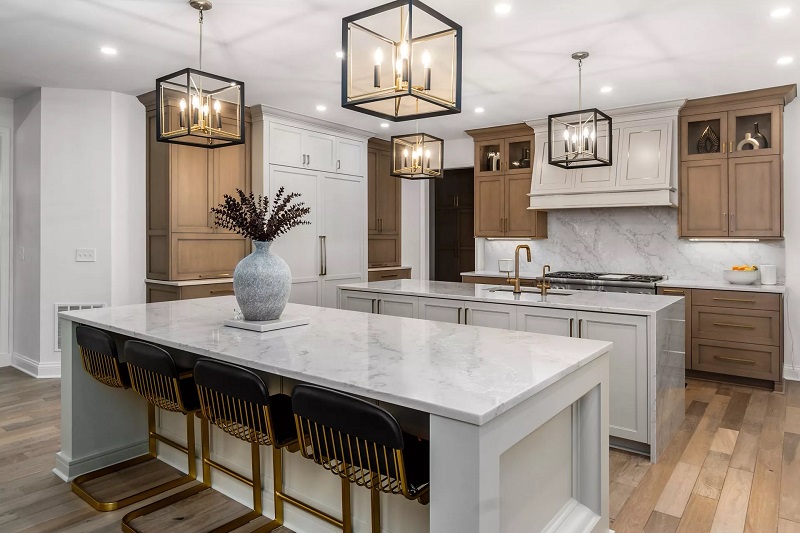

There was a time when kitchen design adhered to an unwritten, ironclad law of uniformity: every piece of metal in the room had to match. If your sink faucet came in brushed nickel, your cabinet knobs, drawer pulls, light pendants, and even the hinges on your pantry door had to be ordered in the exact same finish from the exact same catalog. The result was tidy, safe, and entirely predictable. It was also the quickest way to make a custom kitchen feel like a builder-grade subdivision package or a plumbing showroom display.
In high-end contemporary interior design, that rigid rule has been thoroughly dismantled. Today’s most compelling kitchens treat metal finishes as layered architectural materials rather than a matching set of dinnerware. Mixing metals introduces visual tension, warmth, and depth, giving a space the collected, soulful feeling of a home that evolved gracefully over time.
Yet breaking the old rules does not mean operating without guardrails. When done haphazardly, mixing finishes does not look intentional; it looks like the contractor ran out of parts halfway through installation. Successfully blending cabinet hardware with faucet finishes requires a discerning eye for balance, temperature, and material hierarchy.
Establish a Clear Dominant Metal
The cardinal mistake in mixing finishes is treating the room as an even fifty-fifty split. When two distinct metals compete for equal visual weight across a kitchen, the human eye cannot determine where to rest. The space feels fragmented and unsettled.
To create cohesion, follow the 70/30 distribution rule. Designate one primary metal to serve as the dominant voice covering roughly seventy percent of the room’s metallic surface area, and reserve a secondary metal for the remaining thirty percent.
Because cabinet hardware typically involves dozens of individual contact points across base drawers, uppers, and tall pantry towers, knobs and pulls often naturally claim the dominant role. If you choose polished nickel or aged brass for all your cabinetry, that finish establishes the rhythmic baseline of the room. Your plumbing fixture—the primary kitchen faucet and perhaps an auxiliary pot filler—then steps into the accent role, functioning as a deliberate sculptural statement that punctuates the space.
Master the Nuance of Metal Temperatures
Every metal finish carries an innate thermal personality, categorized as warm, cool, or neutral. Understanding these color temperatures is essential for creating intentional contrast rather than accidental discord.
Warm metals radiate yellow, orange, or red undertones. This family includes unlacquered brass, satin bronze, aged gold, and raw copper. They bring an inviting, humanizing glow to painted millwork and stone surfaces.
Cool metals belong to the silver family: chrome, polished nickel, brushed stainless steel, and pewter. Chrome reads icy and crisp with distinct blue undertones, while polished nickel leans slightly warmer with subtle golden-champagne undertones that shift under varying light.
Neutral metals operate as visual chameleons. Matte black, oil-rubbed bronze, and dark gunmetal possess virtually no chromatic undertones. Because they act as structural punctuation marks—much like the black ink in a line drawing—neutral metals pair effortlessly with almost any warm or cool metal.
Avoid the Perils of the Near-Miss
The golden rule of color temperature is straightforward: commit to high contrast, and actively avoid the “near-miss.”
A near-miss occurs when you pair two finishes that are slightly different versions of the same metal family, such as pairing polished chrome with brushed nickel, or mixing bright polished brass with antique satin bronze. Because the finishes are close in hue but different in sheen and undertone, the pairing looks like an ordering error or a failed attempt to match.
Instead, lean into confident contrast. Pair a cool, mirror-like polished chrome faucet with warm, tactile unlacquered brass cabinet latches. The sharp divergence in temperature makes it clear to anyone entering the room that the contrast was a deliberate stylistic choice.
Balance Reflective Sheens with Matte Textures
Color temperature is only half of the aesthetic equation; surface finish and tactile texture carry equal weight. If every metallic element in the room shares the exact same level of reflectivity, the design falls flat. Conversely, if you combine high-gloss chrome with high-gloss polished brass, the space can quickly become visually overwhelming and cacophonous.
Varying your sheens introduces subtle sophistication:
- Pair a high-shine element with a muted companion. If your gooseneck faucet is mirror-polished nickel, balance its brilliance with satin-brushed brass drawer pulls or matte black bar handles.
- Incorporate textured metals to soften hard surfaces. Knurled hardware, hammered copper prep sinks, or reeded cabinet pulls break up flat reflections, diffusing natural daylight softly across cabinet faces.
- Embrace living finishes. Materials like unlacquered brass and raw bronze are chemically dynamic. Over months and years of daily touch and water splashes, they oxidize, developing a rich, irregular patina that artificial factory coatings cannot replicate. Placing a living finish beside a stable, non-patinating fixture like a stainless steel workstation sink creates a beautiful dialogue between timeless craft and modern utility.
Anchor the Secondary Metal in Multiple Locations
A mixed-metal scheme fails when an accent finish appears only once in isolation. If you install twenty unlacquered brass cabinet pulls and drop in a single matte black pull-down faucet, that faucet risks looking like a random replacement part rather than a design anchor.
To make an accent finish feel grounded, repeat the secondary metal at least two or three times across the room at varied elevations.
If your faucet is finished in matte black, echo that dark metal in the island pendant light collars, the counter stool frames, or the wall-mounted picture light above open display shelving. If your cabinet hardware is aged bronze and your faucet is polished chrome, select a statement range hood with polished chrome banding or install polished chrome library sconces over the backsplash. This deliberate repetition guides the eye through the room, weaving the contrasting metals into a unified visual tapestry.
Account for the Stainless Steel Elephant
Homeowners often panic when planning a mixed-metal kitchen because of their appliances. A forty-eight-inch professional gas range, a built-in French-door refrigerator, and an integrated dishwasher represent an enormous amount of stainless steel surface area. Designers are frequently asked: does the presence of stainless appliances count as one of my mixed metals?
The industry consensus is reassuring: treat large stainless steel appliances as a neutral, foundational backdrop rather than an active decorative metal. Much like a white quartz countertop, an oak hardwood floor, or a plaster wall, stainless steel appliances are functional architectural workhorses.
You do not need to choose a stainless steel faucet or brushed nickel hardware simply because your range hood or oven doors are stainless. A kitchen featuring rich walnut cabinetry, glowing unlacquered brass hardware, a matte black faucet, and stainless appliances works exceptionally well because the black and brass act as intentional decorative jewelry layered against a neutral mechanical backdrop.
Let Cabinetry and Countertop Veining Guide the Choice
Your metal selections should never occur in a vacuum; they must converse with the surrounding millwork and stone surfaces. The undertones of your cabinetry paint and the mineral veining in your countertop slabs will tell you exactly which metals belong in the room.
For instance, deep navy, forest green, or warm off-white cabinetry pairs naturally with the honeyed warmth of aged brass or polished nickel. Crisp, stark white cabinets and cool gray Carrara marble often benefit from the crisp outline of matte black or the industrial precision of polished chrome to keep the palette tailored and modern.
If your quartzite or marble counters feature distinctive caramel and charcoal veining, you have the ultimate blueprint for your metals: let the hardware honor the warm caramel notes while the faucet and light fixtures pull from the deep charcoal striations.
Mixing cabinet hardware and faucet finishes is an exercise in thoughtful tension. By establishing a dominant finish, selecting deliberate temperature contrasts, balancing glossy sheens with tactile textures, and repeating your accent metals with intention, you abandon the sterility of matching sets in favor of a layered, custom kitchen that feels curated, confident, and timeless.